 Coverton Blog
Print selected spreadsheet rows and columns as A4 PDF
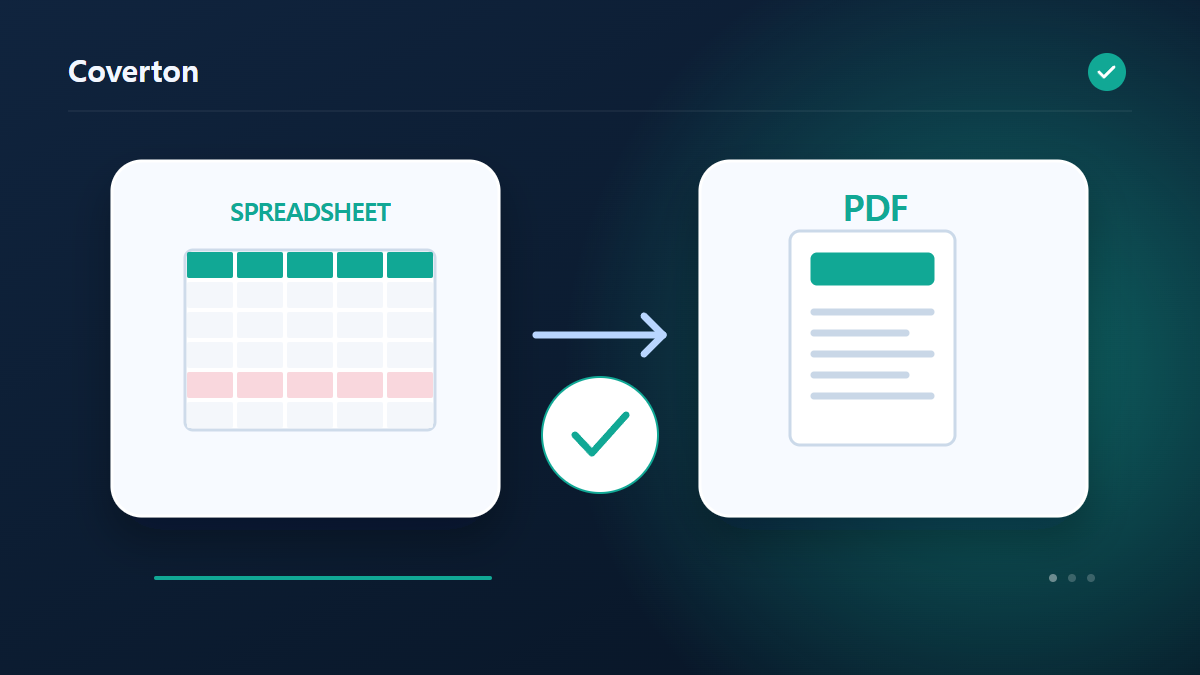
Prepare an A4 document from the rows and columns needed for a particular task. This export focuses on cell values and does not reproduce the original workbook's complex layout.
How to use this tool
- Add the spreadsheet and check its header row and XLSX sheet.
- Choose row range, columns, page orientation and text size.
- Create the PDF and inspect values and lettering across all pages.
- Download the printable PDF.
Choose the right settings
Check the sheet and header row, then specify the data row range and column names to print. Consider landscape orientation for wide spreadsheets and choose a readable printed text size.
Before you start
Establish the meaning of the input
Before converting or arranging data, identify what a row or value represents and keep a source copy. In tabular files, review headers, separators and text encoding; in structured files, inspect the required object or array shape. Identifiers, dates and amounts should not be interpreted solely from how a spreadsheet happens to display them.
Where the tool offers matching columns, type rules or output fields, choose them according to the destination’s requirements. Test a sample with a blank, a repeated value and a value containing punctuation. For labels, charts or personalized documents, check which column supplies each displayed value and whether the source units and wording are correct.
Define a few checks before processing: an identifier that must retain its spelling, a value with a known interpretation and an expected relationship between records. If the tool offers type conversion or matching rules, distinguish a source value from the program’s display of it. Test ambiguous dates or differently written keys before accepting a broad rule. Keep the chosen rules and destination requirements with the result; this makes a discrepancy traceable to input, interpretation or the requested transformation.
Verify values, structure and exceptions
Reopen or import the result using the destination’s settings. Compare headers, record counts and several values with the source, allowing for the operation you requested. A summary, split or duplicate-removal task can legitimately change the count; verify why it changed rather than expecting every transformation to keep identical rows.
Inspect any exception or validation report before continuing. If columns shift, characters are garbled or a key is not found, check delimiters, encoding and exact header spelling first. Encoding data does not encrypt it, and formatting a value does not confirm its meaning. For printed codes or labels, test the actual output before making the full set.
Example input and output
selected sheet rows/columns → A4 spreadsheet PDFExamples describe the workflow. Results depend on the source file and settings.
Check the saved result before using it
Review every PDF page to confirm that the selected rows and columns are present. Inspect Korean lettering, rows at page boundaries and repeated headers before making a test print.
If the result is different from what you expected
Missing charts, merged cells or original styling are limits of this value-based export. Check font support for rejected characters, and use the original editor when exact workbook layout is required.
Limits to keep in mind
- This is a value-based spreadsheet export. Charts, merged cells and original styling are not copied. Korean and Latin glyphs are supported; unsupported characters are rejected.
Continue with a related tool
This guide explains the public browser tool. Keep a copy of the original and inspect the result before sharing it.